Skip to content
01Use cases - real hospital environments

One intelligence layer across the environments hospitals actually run.

ASTA fits general wards, step-down beds, ICU/HCU oversight, peripheral centers, hospital-at-home pathways, and academic programs by reading the monitors already in place and adding continuous clinical visibility without a new monitor fleet.

Built for existing hospital infrastructure
Starts on the monitors already on the ward
Extends from live monitoring into teaching and research
asta workspace — hospital graph2 wards · 25 beds
ASTA hospital brain graph: ward nodes orbiting a central hospital node with connection lines to active patients, and tiles reading 2 wards, 25 beds, 16 active patients
Live · 7 hospitals
Named live hospitals6
States represented1
OEM monitor brands13+
New monitor fleet required0
01Deployment contexts

Where ASTA creates value in real hospital settings.

ASTA is not a ward-specific product. It is a device-agnostic intelligence layer that adapts to each care environment's staffing reality, escalation pattern, and deployment posture.

2.1Acute inpatient care

Continuous oversight for the beds hospitals manage all day.

Operational gain often starts outside the ICU, where teams need broader visibility across mixed-acuity beds without replacing the monitors already installed.

01

Smart wards in general hospitals

General wards and monitored inpatient beds on mixed monitor fleets.

Pressure
Periodic observation and threshold-only alarms can miss deterioration between checks.
Fit
ASTA reads the monitors already at each bed and centralizes watchlists, trends, and escalation across the unit.
Outcome
Broader ward visibility, earlier deterioration cues, and no monitor replacement program.
02

ICU & HCU optimization

ICUs, HCUs, and high-dependency floors under constant bed pressure.

Pressure
Critical-care beds are strained when general floors escalate late or without enough context.
Fit
ASTA extends continuous oversight into the units feeding ICU/HCU escalation, using one layer across floor and critical care.
Outcome
Better step-up timing, stronger escalation quality, and tighter use of scarce critical-care beds.
03

Post-operative and step-down oversight

Recovery beds, monitored post-op units, and night-shift handovers.

Pressure
Subtle drift in oxygenation, pressure, or pulse can matter before a threshold breach appears.
Fit
Trajectory-aware watchlists surface change early while keeping clinicians on familiar monitors and workflows.
Outcome
Safer recovery oversight and fewer blind spots during high-risk observation windows.

ASTA adds continuous intelligence to the inpatient beds where staffing pressure, escalation timing, and throughput matter most.

2.2Distributed and remote coverage

One operational model across the central hospital and the care edge.

ASTA extends monitored oversight into smaller centers and supervised home pathways without splitting into separate technology stacks.

01

Remote monitoring for peripheral centers

Satellite hospitals, peripheral centers, and smaller monitored units without constant specialist presence.

Pressure
Escalation quality weakens when coverage depends only on local staff and disconnected workflows.
Fit
ASTA keeps monitored beds visible centrally and supports specialist review while preserving the equipment already used at the edge.
Outcome
Broader clinical reach and stronger support for tier-2 and tier-3 care environments.
02

Hospital-at-home services

Home recovery, monitored discharge, and supervised chronic-care follow-up.

Pressure
Hospitals need continuity after discharge without training teams on a second monitoring model.
Fit
ASTA extends familiar dashboards, watchlists, and escalation logic into supervised home pathways where they fit the care model.
Outcome
Safer discharge pathways and continuity from bedside monitoring into home observation.

The same ASTA operating model can cover central hospitals, remote sites, and supervised home pathways when hospitals want one deployment language across settings.

2.3Academic and institutional intelligence

A monitored ward layer that also strengthens teaching and research.

For medical college hospitals and academic centers, ASTA supports live monitoring while creating structured material for teaching rounds, protocol work, and publication-oriented research.

01

AI-backed clinical training

Teaching hospitals, academic ICUs, simulation reviews, and protocol teaching.

Pressure
Clinical education often lacks structured, time-linked cases from the institution's own monitored care environment.
Fit
ASTA turns alert timelines, deterioration trajectories, and review history into material for teaching and escalation training.
Outcome
Stronger clinical education grounded in the hospital's own monitored cases.
02

Medical research enablement

Departments running publications, validation studies, audits, or protocol-improvement work.

Pressure
Research slows when vital patterns, escalation events, and review trails stay fragmented.
Fit
ASTA structures longitudinal monitor data and operational history into a research-ready layer.
Outcome
Faster publication workflows, better protocol development, and clearer academic differentiation.

The academic value compounds after go-live: live monitoring first, then teaching material, protocol improvement, and research output on top.

2.4Specialized monitored environments

Operational confidence in regulated and non-acute programs.

Some ASTA deployments are less about bedside acuity and more about traceable monitoring, exception handling, and long-horizon visibility in specialized environments.

01

Blood & organ bank monitoring

Temperature-controlled blood, organ, and other regulated storage environments.

Pressure
Compliance failures and delayed exception response can create patient-safety risk, wastage, and operational exposure.
Fit
ASTA supports continuous oversight, alert routing, and traceable exception handling where special environments demand reliable watchfulness.
Outcome
Stronger compliance posture, lower wastage risk, and more confidence in critical inventory monitoring.
02Expansion path

Rehabilitation & behavioral-health programs

Biofeedback-led rehabilitation, behavioral-health observation, and supervised wellness pathways.

Pressure
Institutions expanding beyond acute beds need structured physiological visibility without standing up a separate monitoring stack.
Fit
ASTA supports longitudinal biofeedback and monitored observation on the same device-agnostic base used in acute care.
Outcome
A controlled path into differentiated programs without diluting the hospital's core monitoring model.

ASTA can begin on live wards and expand into specialized monitored environments once the operating model is proven.

End of section 02
02Academic / teaching hospital value

For medical college hospitals, ASTA becomes more than a monitoring layer.

ASTA gives academic institutions a practical path from live monitoring to stronger clinical education, protocol improvement, measurable patient-safety work, and publication-oriented research. It helps teaching hospitals differentiate on real deployment, not only on technology claims.

Medical college hospitalsAcademic ICUs and teaching roundsProtocol development teamsResearch and publication teams
01

Stronger clinical education

Use alert timelines, deterioration trajectories, and review history as material for bedside teaching, case conferences, and escalation drills.
Teaching rounds
02

Research & publications

Structured longitudinal monitoring data gives academic departments a better base for observational studies, validation work, and publication pipelines.
Publication-ready data
03

Measurable patient safety work

Teams can review deterioration patterns, escalation quality, and protocol adherence using monitored evidence instead of anecdotal reconstruction.
Protocol review
04

Institutional differentiation

Hospitals can show a credible AI-enabled monitoring program operating inside real wards while building academic output and reputation on top.
Academic positioning
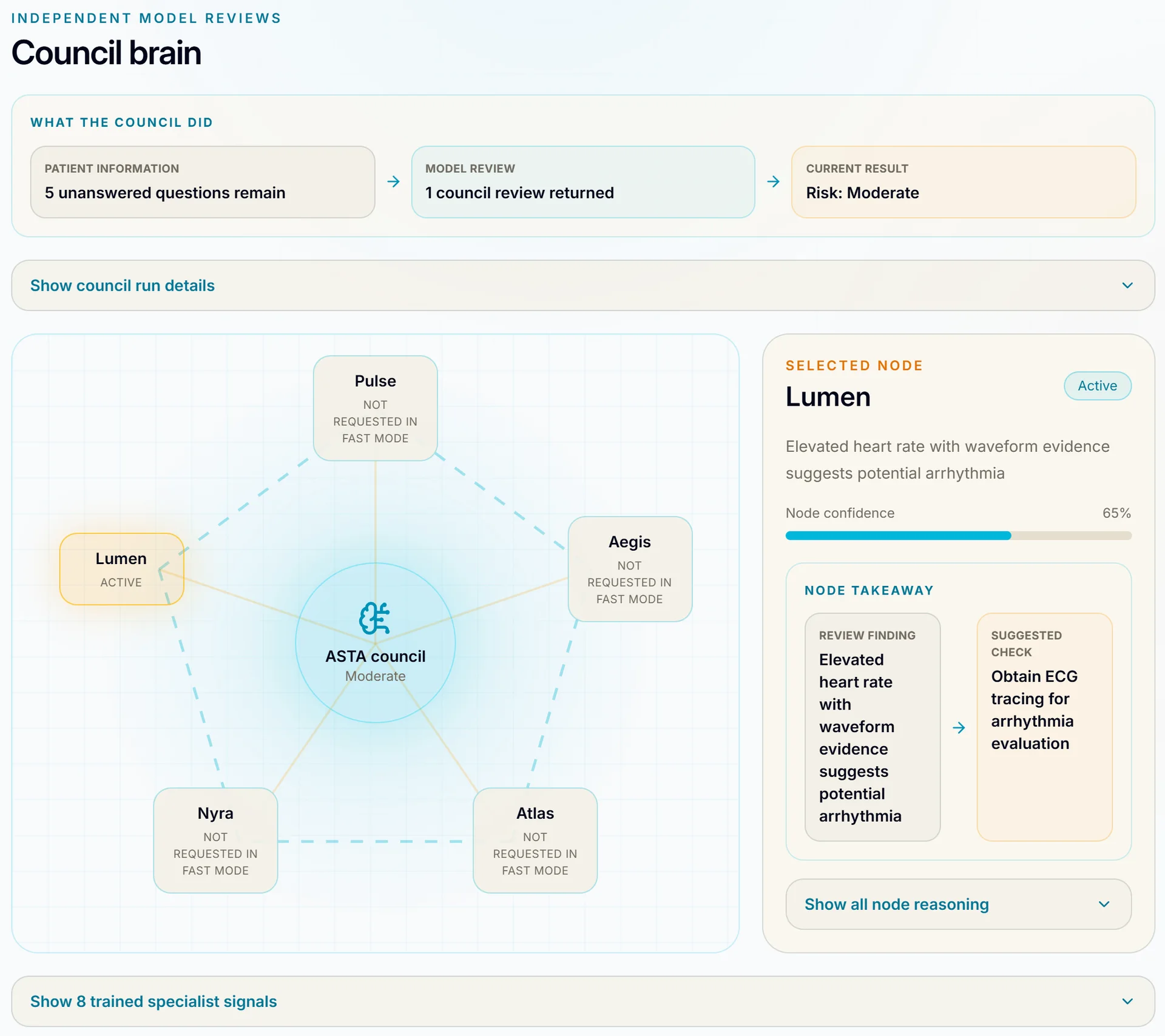
asta — council brain5 model nodes
ASTA council brain view: five independent model nodes — Lumen, Pulse, Aegis, Nyra, Atlas — arranged around the ASTA council, with the selected node Lumen reporting elevated heart rate with waveform evidence and a suggested ECG check
Fig. 1 — Independent model council on one monitored patient: five specialist nodes review the case and return a consolidated risk with per-node confidence · recorded from the ASTA clinical workspace

1. Go live

Start in active wards, step-down units, or academic ICUs on the monitors already in place.

2. Review patterns

Use trajectories and alert history in teaching rounds, protocol review, and escalation discussions.

3. Build research output

Turn structured monitoring data into audits, validation work, and publication pipelines.

4. Differentiate the institution

Demonstrate a real AI-enabled care environment that supports patient safety and academic leadership.

03Live hospital proof

Real deployment contexts, not theoretical scenarios.

ASTA is already live in named hospitals across Tamil Nadu and Karnataka, in active patient-care environments rather than demo scenarios.

Named live hospitals6
States represented1
First public go-live2025
Active patient-care settingsLive
asta — public register2025 — present
01
Southern Railway HQ Hospital
Chennai, Tamil Nadu
General ward monitoring
Live ward deployment supporting continuous patient-care visibility with hospital and railway medical leadership.
Large institutional hospital
Live
02
Karnataka ENT Hospital
Chitradurga, Karnataka
Specialty inpatient workflows
Vital extraction and alert routing aligned to ENT care pathways and specialty inpatient acuity patterns.
ENT-specific monitored care
Live
03
Aksha Hospital
Bangalore, Karnataka
Multi-ward inpatient coverage
Real-time monitoring deployed across active wards for clinical, nursing, and operational teams.
Clinical and nursing operations
Live
04
Seethapathy Clinic
Chennai, Tamil Nadu
Clinic-led monitored care
Continuous observation and escalation routing configured to clinic-specific care protocols and ward patterns.
Continuous observation workflows
Live
05
K.S. Hospital
Kumbakonam, Tamil Nadu
Existing-monitor deployment
Bedside monitor reading configured to the ward layout and equipment already in place at go-live.
No infrastructure change
Live
06
Sugam Hospital
Kumbakonam, Tamil Nadu
Active ward operations
Real-time vital extraction and alert routing configured for continuous operational coverage across active wards.
Continuous ward coverage
Live
07
Anbu Hospital
Kumbakonam, Tamil Nadu
Ward monitoring deployment
Active ward deployment delivered with hospital clinical and operations teams in a live patient-care setting.
Clinical and operations fit
Live

Named sites are shown here as deployment proof: live hospitals, real care settings, and operating fit on infrastructure already in place.

End of section 04
04Outcome framing

Why these deployment contexts matter to hospital buyers.

The value of ASTA changes with the environment. What stays constant is earlier visibility, broader monitored coverage, and a better operating model on the infrastructure hospitals already have.

01Acute floors and recovery beds

Earlier deterioration visibility

ASTA helps teams see meaningful change sooner on wards where periodic observation and threshold-only alarms can leave too much time between signal and action.
02General wards

Broader monitored coverage

Hospitals can extend smart-ward style oversight across more beds without a monitor refresh or a second hardware estate.
03Shift changes and distributed staffing

Reduced staffing blind spots

Continuous visibility helps teams stay ahead of the gaps that appear on larger wards, night shifts, and peripheral sites.
04Escalation workflows

Stronger escalation quality

Alerts arrive with trend context, routing logic, and clinical framing, improving how urgency is interpreted.
05Teaching hospitals and research centers

Teaching and research value

The same deployment that improves live monitoring can also support academic rounds, protocol work, validation studies, and publication-oriented research.
06Special monitored environments

Institutional differentiation and compliance

In regulated environments and differentiated service lines, ASTA supports traceable oversight on a hospital-controlled operating model.
05Deployment review

Discuss ASTA for your hospital setting.

Review the ward types, escalation model, and deployment path that matter most for your hospital - from inpatient monitoring to teaching-hospital use.