
Turning vital signs into life-saving intelligence.
ASTA reads any bedside monitor, extracts structured vitals continuously, and turns physiological signals into role-aware clinical action, without a new monitor fleet.
- 10–20B
- parametersphysiological language model
- 100M+
- labelled framesread from monitor glass
- 15+
- OEM brandsno integration required
- 10+
- hospital deploymentsTamil Nadu · Karnataka
A camera on the monitor. Not the patient.
A camera mounts on the bedside monitor, not the patient. ASTA reads any LCD display from any OEM brand, in any lighting condition, with no API, no hardware tap, and no hospital IT dependency.
Trained on what the monitor saw.
A Physiological Pattern Learning Model evaluates vital trajectories continuously, detects deterioration signals, and produces ranked clinical differentials with evidence links, going beyond threshold logic.
Scroll — the model builds
Rate, rhythm, perfusion — read as one system.
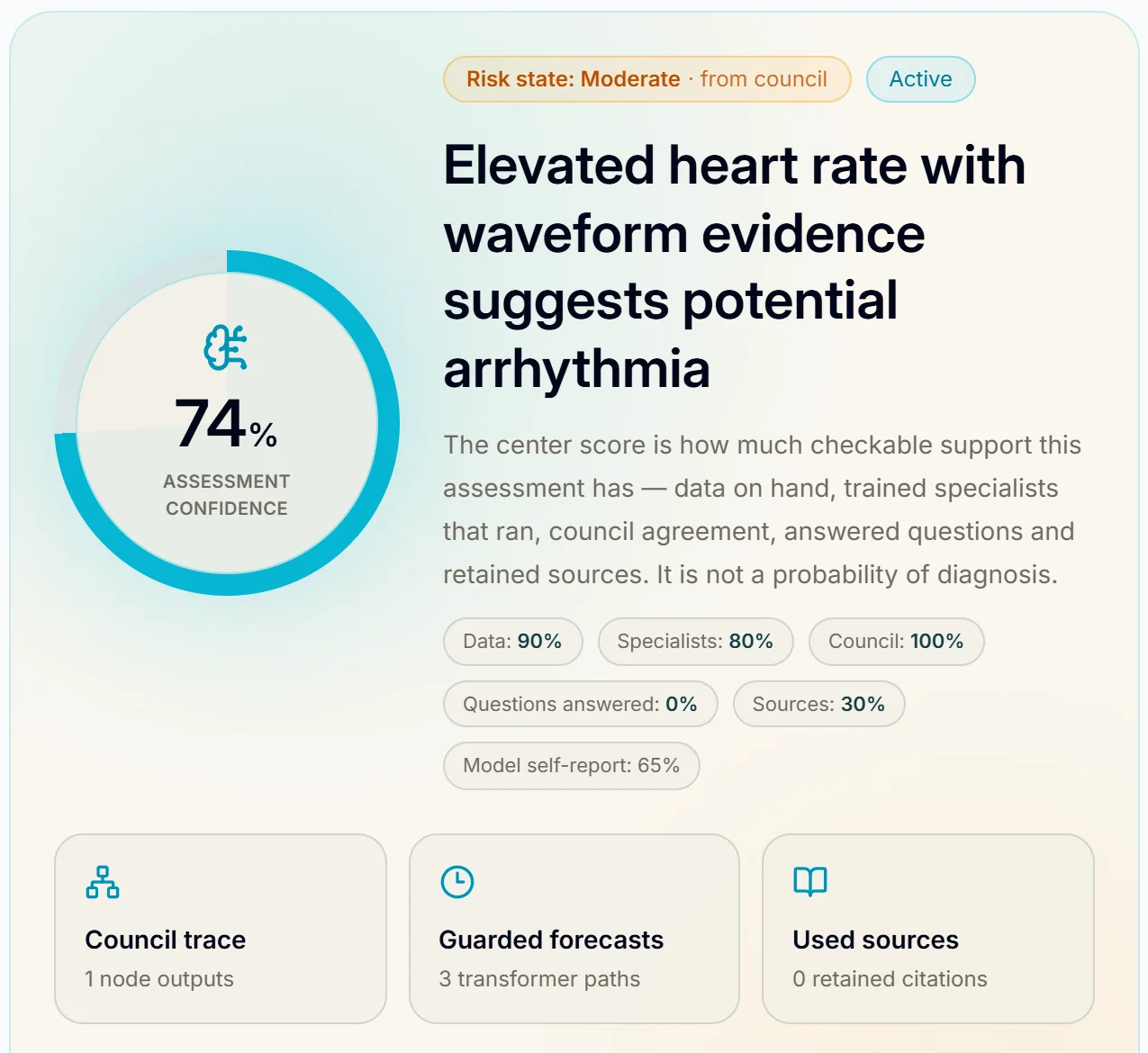
Heart rate, blood pressure and mean arterial pressure are learned together, not thresholded apart. The ECG strip is found in the frame and its beats are marked for clinician review — beat spacing, not a diagnosis.
HR · NIBP · MAP · ECG lead II
Scroll — walk the lab
Evidence-linked alerts. Not alarm noise.
The right alert reaches the right clinician at the right threshold, with physiological trajectory, ranked differentials, and recommended next steps attached. Not alarm noise.
ASTA separates observations, trained scores, forecasts and model reasoning so no single output is mistaken for a diagnosis. PPLM is clinical decision support; every card carries the boundary.
Obtain serial CRP and procalcitonin levels
Elevated CRP and procalcitonin suggest ongoing inflammation or infection; serial measurements assess response to treatment and catch persistent or worsening infection.
The whole ward, live, on one screen.
Nursing and clinical leadership gain a structured, real-time view of every monitored bed across the ward, for handover, continuous oversight, and escalation decisions.
live bed status · NEWS2 · thresholds · critical alerts · image & video review
Scroll — rise out of the ward
10+ hospital deployments, including named live sites across Tamil Nadu and Karnataka.
Named, verified deployments in active patient-care environments. Not pilots, not proof-of-concept installations.
- Southern Railway HQ HospitalChennai · Tamil Nadu · live 2025
- Karnataka ENT HospitalChitradurga · Karnataka · live 2025
- Aksha HospitalBangalore · Karnataka · live 2025
- Seethapathy ClinicChennai · Tamil Nadu · live 2025
- K.S. HospitalKumbakonam · Tamil Nadu · live 2025
- Sugam HospitalKumbakonam · Tamil Nadu · live 2026
- Anbu HospitalKumbakonam · Tamil Nadu · live 2026
Each deployment is operational in an active patient-care environment, in partnership with hospital clinical and technical teams. Public website references included where available.
Monitor reading. Physiological reasoning. Evidence-linked output.
ASTA mounts a camera on the bedside monitor, not the patient, and reads the display. Structured vitals flow continuously into a physiological reasoning layer, and the output becomes role-aware clinical action: context-rich alerts routed to the right clinician, with trajectory and evidence attached.
Computer vision reads any monitor. Physiological reasoning drives clinical action.
- 01
Computer vision reads any monitor
A camera mounts on the bedside monitor, not the patient, and reads any LCD display from any OEM brand. No API. No hardware tap. No hospital IT integration required for the monitoring layer.
- 02
Structured vital extraction
Raw display data becomes structured, time-stamped vitals: heart rate, SpO₂, blood pressure, respiratory rate, extracted at 98% CV accuracy across 15+ OEM brands.
- 03
Physiological reasoning layer
A Physiological Pattern Learning Model evaluates vital trajectories, identifies deterioration signals, and produces evidence-linked clinical context, going beyond threshold alerting.
- 04
Role-aware clinical action
Alerts reach the right clinician with physiological context and trajectory attached, not a bare threshold trigger. The governance trail is captured in the same operational flow.
From monitor reading to clinical action in five continuous steps.
Signal capture to clinical escalation, running continuously across every bed, on infrastructure the hospital already operates.
Capture
A camera mounts on the bedside monitor, not the patient. ASTA reads any LCD display from any OEM brand, in any lighting condition, with no API, no hardware tap, and no hospital IT dependency.
Extract
Computer vision trained on 100M+ labeled monitor frames across 15+ OEM brands extracts structured vitals from the display in real time: heart rate, SpO₂, blood pressure, respiratory rate, at 98% accuracy.
Reason
A Physiological Pattern Learning Model evaluates vital trajectories continuously, detects deterioration signals, and produces ranked clinical differentials with evidence links, going beyond threshold logic.
Alert
The right alert reaches the right clinician at the right threshold, with physiological trajectory, ranked differentials, and recommended next steps attached. Not alarm noise.
Review
Nursing and clinical leadership gain a structured, real-time view of every monitored bed across the ward, for handover, continuous oversight, and escalation decisions.
National innovation backing and research institution support.
ASTA is supported by government-recognised innovation programs and research institutions, grounding a clinical AI product in translational validation and institutional credibility.

AIC-SEED

MeitY Startup Hub

IISER Pune

NIT Andhra Pradesh
Designed for institutional deployment
Numerical vitals only. No patient imagery. Standard monitoring consent. Engineered for regulated clinical environments and hospital governance requirements.
- Numerical data only. No patient imagery.
- Standard monitoring consent
- DPDP-aligned posture
- Legal audit trail
- Role-based access control
A productized monitoring platform, built for hospital deployment.
Every module is engineered to operate inside real hospital workflows: reliable, observable, and operable by clinical staff without specialist technical support.
Real-time vital extraction
Trajectory-aware alerts
Ward-level visibility
Compliance-ready posture
Workflow compatibility
Deployment flexibility
A practical operating model. Not a demo-stage AI promise.
ASTA delivers structured value across clinical, operational, and governance dimensions, with a deployment model designed for how hospitals actually buy and operate technology.
Zero hardware capex. Predictable operating cost.
Proof — Same-day deployment available
Continuous monitoring without disruption.
Proof — Works on existing monitor fleet
Evidence-linked alerts. Not alarm noise.
Proof — Physiological context at escalation
Hospital-owned. Institutionally controlled.
Proof — No patient imagery captured
Numerical data only. Hospital-controlled. Institutionally auditable.
ASTA reads LCD display numerics, not patients. No patient imagery is captured or transmitted. Standard monitoring consent applies. DPDP-aligned architecture, ISO 13485-certified quality management, HL7/FHIR-aligned interoperability, role-based access, and full audit trail, with deployment posture under hospital control.
Fig. 4 — Governance event log (simulated)
Numerical data only. No patient imagery.
Standard consent. DPDP-aligned. ISO 13485 certified.
Full audit trail and role-based access
No IT integration required for monitor reading
See ASTA reading live ward monitors.
A focused 30-minute session with our clinical and engineering team, covering monitor compatibility, ward workflow fit, and deployment requirements for your unit.
ASTA Health Tech