
The intelligence layer behind
smart wards.
A device-agnostic clinical intelligence stack that reads any bedside monitor, structures vitals in real time, reasons over physiology, and turns those signals into evidence-linked clinical action.
Physiological Pattern Learning Model · readings → network → council → forecast
- current risk
- Low
- heart rate · recorded
- 92 bpm
- +15 min · model
- 92.0 bpm
- +30 min · model
- 92.0 bpm
- reviewers
- 1 · Lumen
- returns in
- seconds
Three productized layers. One clinical intelligence system.
ASTA combines monitor reading, physiological reasoning, and clinical output in one continuous path from signal to bedside action.
Escalation advised — 12-lead ECG
74%Computer Vision Layer
- Extracts HR, BP, SpO2, and RR in real time
- Supports 15+ OEM monitor brands
- No API or hardware tap required
- Deploys without vendor lock-in
PPLM Reasoning Layer
- 10–20B parameter physiological language model
- Trajectory-aware reasoning over continuous windows
- Ranked deterioration context
- Evidence-linked interpretation before output
Clinical Output Layer
- Evidence-linked bedside outputs
- Role-aware escalation support
- Recommended next-step framing
- Explainable action at the endpoint
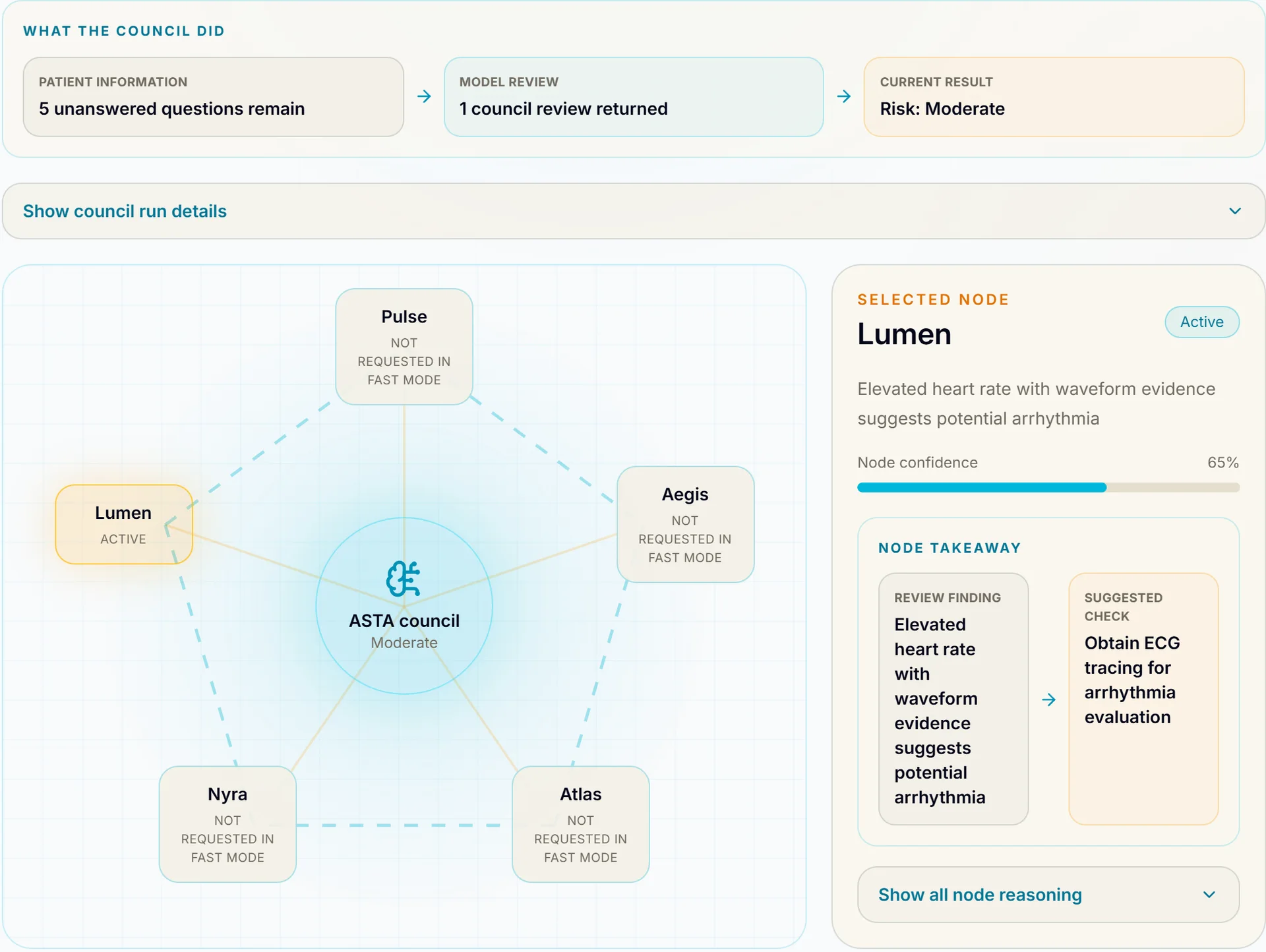
From monitor reading to reasoning to action, ASTA operates as one clinical intelligence loop.
From monitor pixels to clinical action.
A simplified view of how ASTA moves from bedside monitor display to evidence-linked clinical output.
Monitor display
ASTA starts with the bedside monitor already in use.
Structured extraction
Computer vision converts displayed numerics into structured, time-stamped vitals.
Physiological embedding
Vital windows are normalized into machine-readable physiological state embeddings.
Deterioration interpretation
Alerts trigger on vitals exceeding threshold and on camera obstruction detection. PPLM ranks deterioration context above the raw alert.
Clinical output
Vitals are captured continuously every 5 seconds, not static snapshots. Output reflects current patient trajectory, framed for the receiving clinical role.
The monitor-reading layer that unlocks deployment.
ASTA begins on the hospital's existing bedside monitors, so deployment does not wait on proprietary integrations, hardware taps, or a monitor refresh cycle.
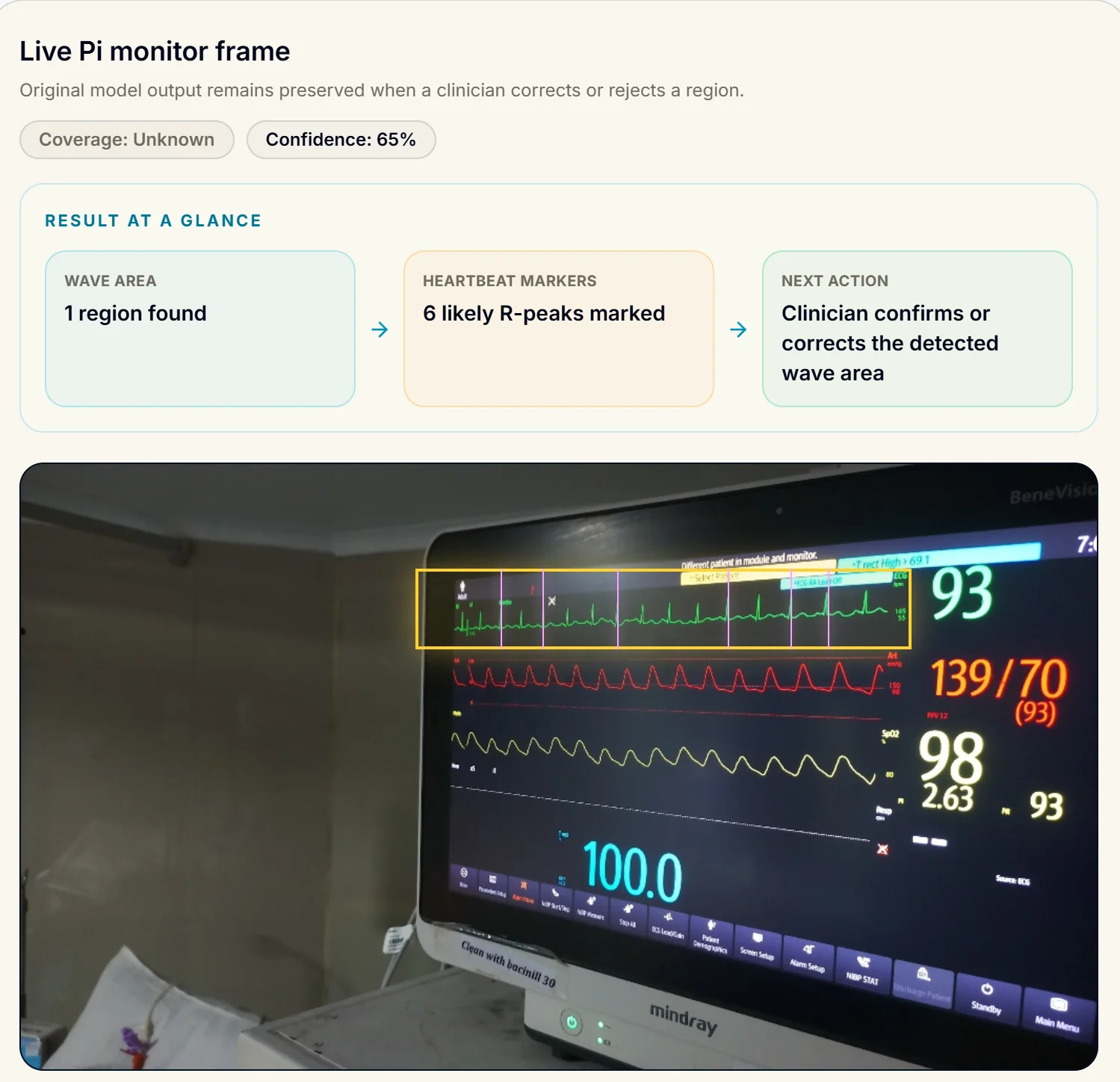
Reads existing bedside monitors
Real-time structured vital extraction
No monitor-side IT dependency
Monitor-facing capture, not patient surveillance
Identify the bedside monitor region in the capture frame.
Recognize OEM-specific layouts and select the right reading template.
Apply OCR and parsing to vitals and displayed numerics.
Time-stamp and standardize values for downstream reasoning.
Identify the bedside monitor region in the capture frame.
Recognize OEM-specific layouts and select the right reading template.
Apply OCR and parsing to vitals and displayed numerics.
Time-stamp and standardize values for downstream reasoning.
Vendor-agnostic monitor reading makes ASTA additive to the infrastructure already in place.
Physiological reasoning beyond threshold-only monitoring.
PPLM is what turns monitor reading into clinical intelligence. A 10–20B parameter physiological language model reasons over continuous trajectories and pattern shifts so output reflects deterioration context, not just a line crossing or a static score. Live deployment integration is coming soon.
Continuous trajectories
Pattern interpretation
Ranked clinical context
Evidence-linked output
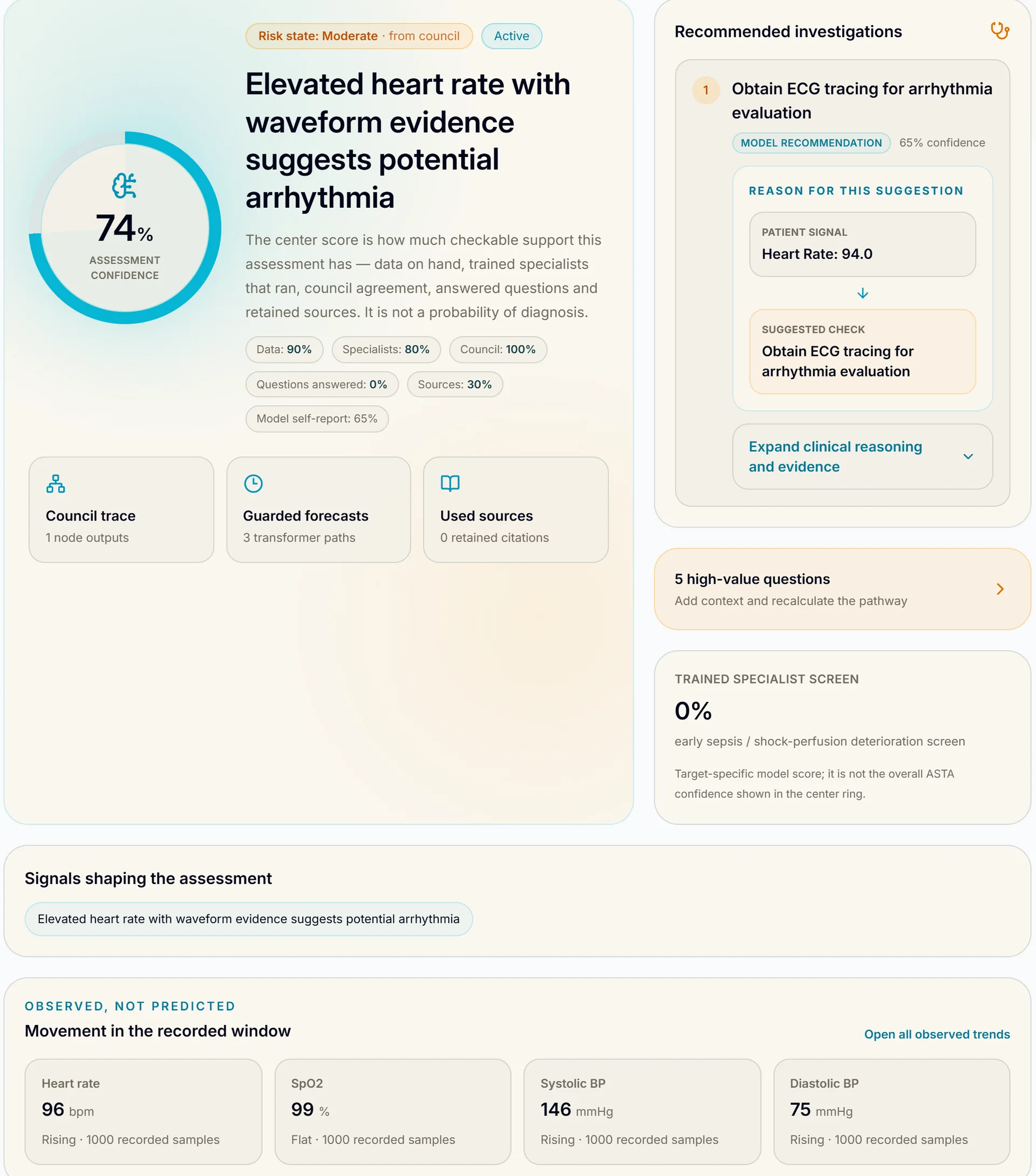
Threshold-only alerts
Escalate after a single value crosses a line.
Static dashboards
Show status snapshots but do not reason over change over time.
Simple OCR systems
Extract numbers accurately but stop before clinical interpretation.
ASTA PPLM
Interprets trajectories, adds deterioration context, and produces evidence-linked output that is more useful than a simple alert.
This is where ASTA moves beyond monitor reading into clinically useful reasoning.
Designed to fit hospital environments, not rebuild them.
ASTA fits hospital environments with monitor-facing bedside capture, a controlled processing posture, and interoperable outputs across on-prem, hybrid, or managed cloud deployment.
Bedside capture
Monitor-facing capture reads displayed numerics from the bedside monitor already in use.
Local extraction
Vital streams are extracted, normalized, and buffered for continuous downstream reasoning.
Controlled deployment posture
Hospitals can adopt on-prem, hybrid, or managed cloud deployment under their own governance model.
Interoperable outputs
Structured outputs and escalation context can map into HL7/FHIR-aligned workflows when needed.
Numerical data only
Hospital-defined data residency
Flexible infrastructure posture
Additive integration model
Monitor reading starts without hospital IT integration. Workflow and EMR connectivity can be added as later layers, not day-one prerequisites.
Proof points that stand up to technical review.
ASTA's public proof stays focused on what serious buyers need to evaluate: monitor-reading accuracy, cross-OEM coverage, training scale, field deployment, and end-to-end latency.
Monitor reading
98% CV accuracy across 15+ OEM monitor brands
Shows cross-device monitor reading rather than one-vendor optimization.
Training scale
100M+ labeled monitor frames
Supports layout robustness across real display conditions.
Real-world operation
10+ hospital deployments and 25 live devices
Shows field usage in hospital environments, not just lab validation.
For platform evaluation, ASTA leads with monitor-reading accuracy, device breadth, real hospital operation, and low-latency output.
Review ASTA's platform architecture and deployment fit.
A focused session with the ASTA platform team covering monitor compatibility, reasoning architecture, deployment posture, and technical fit for your hospital.